San Francisco Modern Art San Francisco Modern Art Museum
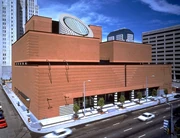
SFMOMA
The San Francisco Museum of Mod Art (SFMOMA) is a major mod and contemporary art museum and San Francisco landmark.
Information technology opened in 1935 under founding managing director Grace 50. McCann Morley (1935–1958) equally the San Francisco Museum of Fine art, the starting time museum on the West Declension devoted solely to 20th-century art. For its first sixty years, the museum occupied upper floors of the State of war Memorial Veterans Building in the Civic Center. In a major transformation and expansion, in 1995 the museum moved to its electric current location next to Yerba Buena Gardens in the SOMA district and its iconic architectural showpiece facility designed by Mario Botta.
The museum has in its collection: important works by Henri Matisse, Diego Rivera, Frida Kahlo, Jackson Pollock, Marcel Duchamp, René Magritte, Mark Rothko, Eva Hesse, Louise Bourgeois; major holdings of Paul Klee, Clyfford Yet, Philp Guston, Robert Rauschenberg, Ellsworth Kelly, and the post-minimalists; photographers ranging from Fox Talbot and Watkins through Stieglitz, Weston, and Adams to contemporary work; and important collections of architecture and design and media arts.
Contents
- 1 Mission Argument
- 2 History: Overview
- iii The Building: Architectural overview
- 3.i A Edifice of Modernist Pattern
- 3.2 Interior Spaces and Facilities
- 3.3 SFMOMA Rooftop Garden
- 4 Curatorial Departments
- 4.1 Department of Painting and Sculpture
- iv.2 Section of Photography
- 4.three Department of Compages and Blueprint
- iv.4 Department of Media Arts
- 4.v Department of Education and Public Programs
- 4.6 Conservation and Research Library/Athenaeum
- v See also
- 6 External Links
Mission Argument [ ]
The San Francisco Museum of Modern Fine art is a dynamic center for modern and contemporary art. The Museum strives to engage and inspire a various range of audiences by pursuing an innovative program of exhibitions, didactics, publications, and collections activities. International in scope, while reflecting the distinctive graphic symbol of California and San Francisco Bay Expanse, the Museum explores compelling expressions of visual culture.
History: Overview [ ]
The first museum on the West Declension devoted solely to 20th-century art, the San Francisco Museum of Fine art opened in 1935 under the direction of Grace L. McCann Morley. The Museum, which celebrated its 50th anniversary in 1985, rose to international prominence under the leadership of Henry T. Hopkins (1974–86) and John R. Lane (1987-1997). "Modern" was added to the Museum's title in 1975 to describe its purview more accurately.
Betwixt 1987 and 1997, under managing director John R. Lane the Museum established ii new curatorial departments — architecture and design and media arts — and elevated the position of director of education to a total curatorial role. SFMOMA began collecting on an international scale and undertook an increasingly active special exhibitions program, organizing traveling exhibitions such as Sigmar Polke (1991), Jeff Koons (1991) and Dorothea Lange, American Photographs (1994), all the while building its new facility in the burgeoning South of Market district, designed past renowned Swiss builder Mario Botta. On the musuem's sixtieth anniversary, January eighteen, 1995, SFMOMA opened its new building, which finally provided space for simultaneous brandish of special exhibitions and its permanent collection.
Under David A. Ross, manager of SFMOMA from 1998 to 2001, the museum caused a number of major works of fine art for the permanent collection, including xiv seminal pieces by Robert Rauschenberg; 22 important works by Ellsworth Kelly; René Magritte's Les Valeurs Personelles, (Personal Values; 1952); two important tardily paintings by Piet Mondrian: Composition with Red, Yellow and Blue (1935–42) and New York Urban center ii (Unfinished), 1941; a lead plane sculpture past Anselm Kiefer entitled Melancholia (1990–91); and Marcel Duchamp's iconic Fountain (1917/1964). The Museum made a proper noun for itself collecting websites and digital projects and simultaneously presented the pathbreaking exhibitions 010101: Art in Technological Times and Points of Divergence: Connecting with Contemporary Art. The onetime modeled the affect of digital culture on the processes of art-making; the latter prototyped the museum of the future, with interactive educational technologies integrated in the galleries alongside the artworks.
Neal Benezra succeeded David Ross every bit managing director in 2002. The following year SFMOMA presented the phenomenally successful Marc Chagall exhibition, hosting more than than 115,000 visitors in October—more than any other month in its history. Likewise in 2003 the Museum's Koret Visitor Education Center, the first educational facility at an American fine art museum to offer drib-in public access, opened to the visiting public on a full-fourth dimension ground. Amid the almost 600 works acquired in 2004, of particular note were Suspension of Disbelief (for Marine) (1991–92), a video installation past Gary Hill; Tide Table (2003), a picture show and suite of related drawings past the S African creative person William Kentridge; and Atrabiliarios (1992–2004), a mixed-media installation by the Colombian artist Doris Salcedo. Prentice and Paul Sack fabricated a promised souvenir of virtually 800 photographs from their individual collection to the Prentice and Paul Sack Photographic Trust.
Prominent exhibitions SFMOMA has organized in recent years that have traveled around the world include: Sol LeWitt, A Retrospective (2000), Ansel Adams at 100 (2001), Eva Hesse (2002), Diane Arbus, Revelations (2003), Richard Tuttle, The Fine art of Richard Tuttle (2005), Chuck Close, Cocky Portraits (2005), Robert Bechtle, A Retrospective (2005), Shomei Tomatsu, Skin of the Nation (2006). Upcoming is the start American retrospective of Olafur Eliasson, slated to open up at SFMOMA in September 2007. In 2008 the museum revised its public photography policy to allow non-flash photography for personal apply of the permanent drove and some special exhibitions.
The Building: Architectural overview [ ]
For the first lx years of SFMOMA'due south being, the Museum was housed in the Beaux Arts–style War Memorial Veterans Building, located in San Francisco'southward Borough Center. In Jan 1995 the Museum celebrated its 60th anniversary past opening a new building.
The Museum's current building on Third Street was designed by Swiss architect Mario Botta, representing Botta's first U.S. project and first museum; Hellmuth, Obata and Kassabaum, Inc. served equally the architect of tape. The 225,000-square-foot building, one of the largest new American art museums of the decade and the second largest single structure in the U.s.a. devoted to modern art, replaces the Museum'southward erstwhile location at the State of war Memorial Veterans Building. The Museum is located in San Francisco's downtown southward of Market area (SOMA) and is surrounded past numerous other cultural institutions, including the Center for the Arts at Yerba Buena Gardens.
A Building of Modernist Design [ ]
Mario Botta, an internationally acclaimed architect based in Lugano, Switzerland, conceived a edifice for SFMOMA in the tradition of Modernist design. The edifice features an impressive stepped-back brick-and-rock facade that is distinguished by a soaring truncated cylinder emerging from the roof. To the rear, the building consists of a five-story belfry that houses galleries as well every bit Museum offices.
Interior Spaces and Facilities [ ]
Reflecting the influence of architect Louis I. Kahn, the edifice is flooded with natural light and offers generous open spaces. The full-height central atrium court illuminated past the skylit cylinder and crossed by a steel skybridge is a key feature of the interior infinite. In addition, the skylit roofs offer generous natural light to many galleries.
Visitors are drawn from the ground floor atrium court upwards to the iv floors of galleries via a chiliad staircase. The offset gallery floor, with 16-foot ceilings, houses selections from the permanent collection and provides space for the architecture and design program. An intimate second gallery floor displays photographs and works on newspaper. The top ii gallery floors, with lofty xviii- and 23.five-pes ceilings, accommodate special temporary exhibitions and large-calibration gimmicky fine art from the Museum's permanent collection.
On Oct 12, 2002, the Museum unveiled the 7,000 square foot Koret Visitor Education Center. Situated at the heart of the Museum side by side to the galleries on the 2d flooring, it is the first educational facility at an American art museum to offer drop-in public access likewise as a full agenda of scheduled programs and activities.
SFMOMA Rooftop Garden [ ]
In 2005, seeking ideas for the display of the Museum'south growing number of large-scale sculptures, SFMOMA invited six innovative Bay Area firms — Mark Cavagnero Assembly, envelopeA+D, Fougeron Architecture, Jensen & Macy Architects, Kuth/Ranieri Architects, and Pfau Architecture — to participate in a competition to design a rooftop sculpture garden atop the SFMOMA parking garage. Their brief: to transform the roof of the SFMOMA Garage into a sculpture garden accessible from the fifth-floor galleries. On May 5th, 2006, SFMOMA appear Jensen & Macy Architects as the winner of the competition. The studio's hit proposal situates the sculpture garden every bit an integral function of the Museum's exhibition space, with a cantilevered window overlook from—and back into—the existing 5th flooring galleries. The new xiv,400 foursquare feet will include a transparent, sheltering pavilion and volition offer aplenty space for the exhibition of rarely seen sculptures in the Museum'south holdings, including notable works past Alexander Calder, Alberto Giacometti, and Henry Moore besides as Louise Bourgeois, Mark di Suvero, Ellsworth Kelly, Bruce Nauman, and Barnett Newman. The sculpture garden opened to the public in the spring of 2009 and includes a cafe.
Curatorial Departments [ ]
Section of Painting and Sculpture [ ]
The painting and sculpture collection is distinguished past major works past artists associated with the American Abstract Expressionist School, notably Clyfford However, Jackson Pollock, Philip Guston, Arshile Gorky, Mark Rothko and Richard Diebenkorn. It has strengths in Fauvism, particularly the works of Henri Matisse; Mexican painting, particularly central works by Diego Rivera and Frida Kahlo; and the art of the San Francisco Bay Area. The Museum is also widely known for the important gifts and promised gifts of works past Paul Klee from Dr. Carl Djerassi and the Djerassi Art Trust; and for its very active gimmicky art acquisitions plan. John Caldwell served as curator of painting and sculpture from 1988 to 1993. Gary Garrels was the Elise S. Haas chief curator and curator of painting and sculpture from 1993 to 2000. Madeleine Grynsztejn followed Garrels in the Haas chair equally Senior Curator of Painting & Schulpture until December 2007, notably organizing retrospectives of artists Richard Tuttle and Olafur Eliasson and adding important works past artists such equally Giorgio Morandi, Gordon Matta-Clark, Robert Smithson, Ann Hamilton, Doris Salcedo, and Kiki Smith to the drove. Janet Bishop was appointed the Andrew Due west. Mellon Foundation associate curator of painting and sculpture in 1992 and, in 2000, was promoted to the position of curator of painting and sculpture
Department of Photography [ ]
More than l years agone, the Museum was 1 of the first to recognize photography equally an fine art form. This early focus was initiated by Curator John Humphrey (1935-78). Under the direction of Van Deren Coke (1979-87), the Department of Photography gained international stature. The photography department is the simply ane whose purview reaches back before 1900, to the invention of this quintessentially modern medium in 1839. The collection includes specially fine holdings of works past Alfred Stieglitz, Ansel Adams, Edward Weston, the German avant-garde artists of the 1920s, the European Surrealists of the 1930s and 19th century photographers including William Henry Fiox Talbot, Roger Fenton, Julie Margaret Cameron, Carleton Watkins, and Eadweard Muybridge. Sandra Southward. Phillips has served equally curator of photography since 1987, and equally senior curator since 1999.
Department of Architecture and Design [ ]
In 1983, SFMOMA became the first West Coast museum to establish a Department of Compages and Design. The department was established under the guidance of erstwhile director Henry T. Hopkins (1974–1985) to collect, showroom and educate in the disciplines of compages and design with emphasis on the West Coast and Pacific Basin regions. Paolo Polledri was named SFMOMA'southward offset curator of architecture and design in 1987, organizing such landmark exhibitions as Visionary San Francisco (1990) and Shin Takamatsu (1993). Polledri was succeeded in 1995 past Aaron Betsky, among whose exhibitions were Icons: Magnets of Meaning (1997); Far Out: Bay Area Design, 1967-1973 (1999); Tiborocity: Design and Undesign by Tibor Kalman, 1979-1999 (1999), co-organized by Kalman; Sitting on the Edge: Modernist Design from the Drove of Michael and Gabrielle Boyd (1999); and Design Itinerant: Athletic Shoes 1995-2000 (2000). In 1999 Betsky expanded the compages and design department'southward curatorial purview to include digital projects and began collecting Web sites as design objects.
Joseph Rosa was named the Helen Hilton Raiser Curator of Architecture and Design in January 2002, becoming the first to occupy the newly endowed curatorship. With a smashing interest in digital fine art, Rosa collected a number of digitally produced drawings, images, and models past such architectural innovators equally Preston Scott Cohen, R+Sie, Kolatan / Mac Donald, and Greg Lynn. In 2006 Henry Urbach succeeded Joseph Rosa, serving every bit the new Helen Hilton Raiser curator of architecture and design.
Department of Media Arts [ ]
In early on 1988, the Department of Media Arts was established to develop a program of exhibitions and educational events related to video, media-dependent operation art, and flick. Robert R. Riley served as the section's first curator, focusing on video'due south roots in single channel and installation works exploring the phenomenology of perception. Benjamin Weil succeeded Riley, serving every bit curator of media arts from 2000 to 2005. Since its inception, the media arts department has grown to reflect the diversity of current art production technologies, ranging from video and digital moving-picture show experiments to Spider web projects. Rudolf Frieling was appointed SFMOMA's curator of media arts in January 2006.
Department of Education and Public Programs [ ]
As a complement to its exhibition schedule, a full plan of lectures, special events, and activities targeted for seniors and children incorporate SFMOMA's educational outreach efforts. These interpretive programs are complemented by a corps of over 200 docents who lead tours and other activities related to the Museum's collections and exhibitions. Beginning in 1995, nether the leadership of John Weber, the first Leanne and George Roberts Curator of Education and Public Programs, and Acquaintance Curator Peter Samis, the Education department's Interactive Educational Technologies (IET) team has distinguished itself through the innovative use of new technologies every bit a mean of enhancing visitor understanding of modern and contemporary art, receiving a number of important media and technology awards. Notably, they have developed Making Sense of Mod Art, an interactive online and in-gallery feature that offers an extensive and engaging guide to modern and contemporary artworks in the Museum'due south permanent collection. IET features have won vi Muse Awards from the American Association of Museums, a people's vocalization Webby Award for the site Pecker Viola, prizes from I.D and Communication Arts magazines, and a Gold Apple Award from the National Educational Media Network. A full listing of SFMOMA'due south accolade-winning IET programs is available at http://www.sfmoma.org/instruction/edu_online.html.
In 2005, the museum also inaugurated SFMOMA Artcasts, its podcast fine art-zine, co-produced with Antenna Audio and now published on an 8-week cycle. In 2006, SFMOMA was recognized as a eye of excellence by the New Media Consortium. In 2007, SFMOMA Artcasts were recognized with a Best of the Web award in the category "Innovative and Experimental" at the briefing Museums & the Web.
Dominic Willsdon succeeded John Weber in January 2006 every bit the Leanne and George Roberts Curator of Education and Public Programs, with a brief to expand Education Department activities through an ambitious mix of picture show programming, live and participatory fine art events. SFMOMA Scavengers, a city-broad activity organized by British artist Joshua Sofaer, mobilized teams throughout the city in a found object hunt that culiminated in a 3-day exhibition at the museum in Oct 2006.
Conservation and Research Library/Archives [ ]
The Elise South. Haas Conservation Studio is a major West Coast facility specializing in the e'er increasing treatment of modern and contemporary paintings, works on paper and objects made with a variety of materials and techniques, both analog and digital. In improver to caring for objects in the Museum's permanent collection, the laboratory offers professional person services to other institutions. Jill Sterrett has served as head of conservation since 2000. In 2005 she was appointed Director of Conservation and Collections.
The Museum's Research Library comprises more than 80,000 items, including monographs, exhibition catalogues, and general art resources, too as i,920 serials titles. Also included are the Tillim Collection and Margery Mann Drove of books on the history of photomechanical reproduction in photography and photography more than generally, the Skowhegan Lecture Archives, and a collection of artist books. The Library is open up by appointment to outside scholars and independent researchers. The SFMOMA Athenaeum comprises the institutional history of the museum, its administration, curatorial departments, exhibition schedule, etc. The Archives is accessible, by application, to serious scholarly researchers.
See likewise [ ]
- San Francisco Museum of Mod Art↑
External Links [ ]
- SFMOMA Website
- SFMOMA Drove
- Making Sense of Modern Art
- SFMOMA Interactive Educational Technology programs
schultzsuctioughat.blogspot.com
Source: https://museums.fandom.com/wiki/San_Francisco_Museum_of_Modern_Art
0 Response to "San Francisco Modern Art San Francisco Modern Art Museum"
Post a Comment