What Is a Better Margarine or Butter to Prevent Cholesterol Issues
Butter gets points for sense of taste; margarine for being easy to spread. Simply the healthiest option is non strictly called butter or margarine – it'south a "spread".
To improve the health of your eye, choose a spread with the everyman amount of saturated fat and trans fat per 100 grams. You volition detect this information in the "per 100 grams" cavalcade of the nutrition information panel.
Butter contains about 50% saturated fat, while margarine has a maximum of 20% saturated fat. The fatty content of "light" or fat-reduced spreads is lowered by replacing some fat with protein and water, meaning many are much lower than xx%.
If yous choose a full-fat spread (best for cooking), aim for less than 27 grams of saturated fat and 1 gram of trans fat per 100 grams. For fatty-reduced spreads (best for bread and toast), aim for less than six grams of saturates and 0.2 grams of trans fat per 100 grams.
Ingredients
For a production to be called butter, information technology must be derived exclusively from milk and ingredients that are obtained from milk, including at to the lowest degree 80% milk fatty. Information technology may too incorporate water, table salt, lactic acid producing microorganisms and flavour-producing microorganisms.
When yous come across products in the supermarket that are packaged up like butter, or employ words such every bit "butter-flavoured" without specifically stating the product is butter, information technology'southward likely they have been altered in such a way that it no longer meets the content requirements above.
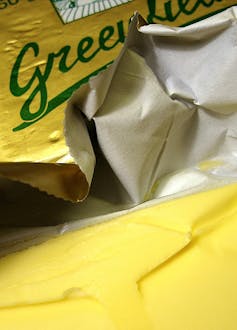
To call a spread margarine, the product must be a spreadable nutrient made of edible oils and water, containing at to the lowest degree fourscore grams of edible oils per 100 grams. Information technology may besides include water, edible proteins, common salt, lactic acid-producing microorganisms, flavour-producing microorganisms and milk products.
Some margarines contain added constitute sterols and stanols, a type of fat found in vegetable oil, basics, legumes, grains, cereals, wood pulp and leaves, which are able to reduce cholesterol absorption from the small intestine into the bloodstream. If you have high blood cholesterol, you may desire to use such a product, though y'all demand to consume xx to 25 grams per 24-hour interval for the maximum outcome.
Every bit soon as the fat content of margarine drops below 80 gram per 100 grams, it cannot technically be called "margarine". This is why the word "margarine" does non appear on labels for spreads that are fat-reduced. These are the healthiest options if you are trying to reduce your full fatty and kilojoule intake.
If y'all are trying to lower your common salt intake, check the sodium column on the nutrition information panel and aim for less than 400 milligrams per 100grams.
Cholesterol and saturated fat
Although the debate rages nigh the potency of specific fats in raising blood cholesterol, near Australians consume too much saturated fatty from animal products. Saturated fat from foods and drinks gets manufactured in your body into low-density-lipoprotein (LDL) cholesterol, or commonly referred to as "bad" cholesterol, which and then appears in your blood.
Excess LDL cholesterol that cannot exist cleared by the liver ends upwards lining your avenue walls. This makes your blood vessels hard and inflexible and they gradually get blocked. From there, it is just a matter of time before the blockage triggers a heart attack or stroke.
Saturated fatty is a solid at room temperature and is the predominate fat plant in the white fat in meat and dairy products, including milk, cheese, cream and butter.

Replacing butter for a spread that has a lower level of saturated fatty is not the only change that can help lower your full saturated fat intake. For many Australians, the majority of their saturated fatty comes from full-fat dairy, foods processed using palm oil or coconut oil, fried and fat takeaway food, and packaged biscuits, cakes, pastries and dips.
The healthier fats are monounsaturated (avocados, almonds, cashews, peanuts, cooking oils fabricated from sunflower, canola, soybean, olive, sesame and peanut) and polyunsaturated (omega-vi fats from sesame seed, margarine, linseed or flaxseed, sunflower and safflower oil, pino basics and brazil basics; omega-iii fats from walnuts, linseed and oily fish such equally tuna, salmon, sardines and bluish mackerel).
The i exception is trans fat. Technically it is an unsaturated fat. Nevertheless, chemically it behaves exactly like saturated fat and increases LDL cholesterol. The problem is that trans fatty also lowers HDL, the "good" cholesterol that carries circulating LDL dorsum to the liver rather than it being deposited on artery walls.
In Australia, trans fat levels in spreads are amongst the lowest in the globe. While most nutrition data panels betoken trans fat content of spreads, companies currently do not have to report it. When the nutrition data panel does not study trans fats, check the ingredients list for hydrogenated oil and partially hydrogenated vegetable oil, from which trans fats are derived.
No affair what the type of fatty, they all have the aforementioned kilojoule value of 37kJ per gram. So, whether you opt for butter, margarine, a fat spread, zero, or perhaps some avocado, hummus or tahini paste, continue an eye on the total saturated plus trans fat, and the kilojoules. And overall, try to choose foods that accept a amend fatty quality.
schultzsuctioughat.blogspot.com
Source: https://theconversation.com/health-check-whats-healthier-butter-or-margarine-19777
0 Response to "What Is a Better Margarine or Butter to Prevent Cholesterol Issues"
Post a Comment